Agrigento, stretched across a hill overlooking the glorious blue of the Mediterranean enjoys its status of being Sicily's oldest and busiest tourist site. Although the town today is rather more infamous for being home to a number of the island's more notorious Mafia famililes (as many a burnt out building can bear witness to). We, along with many busloads of tourists had come to see the mighty Valley of the Temples.
Back in the 8th century BC this part of Sicily together with the regions of Calabria and Basilicata on the toe of the mainland formed a series of formidable independent Greek city-states collectively known as Magna Graecia. The reconstructed ruins here at Agrigento bear testimony to the success and wealth of this civilisation, with Agrigento, or Ancient Akragas, widely considered to be the most luxurious of them all.
Here were some truly amazing examples of ancient architecture, standing proud on a ridge above the sea... While three major temples have since been restored, the most magnificent, the Temple of Jupiter, which was never in fact completed, now lies in a pool of rubble. It would have covered an area of 112m by 56m with columns rising 20m high, supported by colossal human statues known as telamoni - totally massive.
One of the other more intriguing sites was of the blocks carved with what looks like a giant U. These were part of an ingenious pulley mechanism which enabled these early peoples - or rather their slaves - to hoist the blocks up into place.
We managed a good three hours or so wandering around the ruins on what had to be the hottest, most oppressive days of the trip ever. You know the kind, where sweat is literally running off you and your clothes are plastered to your skin, and you then run out of drinking water, and there is not a scrap of shade to be had anywhere. Oh the lengths one goes to in the pursuit of culture! Fortunately the archaeological museum managed to provide many a cool, dark room in which to recover, but the 1km walk to it, following the traipse around the temples very nearly did me in, and the afternoon had to be spent recovering at the beach...
SJ
Thursday, August 23, 2007
Tuesday, August 21, 2007
Villa Romana del Casale
Being very big fans of mosaic art we were drawn to the small, provincial town of Piazza Armeria to pay a visit to the nearby Villa Romana del Casale. This stunning 3rd century AD Roman villa was once the home of Marcus Aurelius Maximianus, and in keeping with being the hunting lodge of the co-Emperor of Rome, it needed to be decorated to a suitable standard...and so enter the very best mosaic artists of the day!
The villa itself was buried under mud following a flood in the 12th century, and the mosaics remained hidden for 700 years before being rediscovered in the 1950s. The mosaics cover almost the entire floor area of the villa - some 3500sq metres, and are considered to be some of the foremost and extensive examples of this form of Roman art in Italy. The range of subject
matter is quite considerable, ranging from classical Greek mythology to battles, African hunts and fishing expeditions. They are however in quite some state of disrepair, and it was both very interesting, but also quite alarming to watch the teams of young archaelogical(?) students undertaking the painstaking restauration work...it all seemed quite casual, and we didn't see
as much respect for this ancient art as we'd expect.
We were also quite surprised at the housing of the complex. A clear plastic roof had been erected over much, but certainly not all of the works, with narrow catwalks for the tourists to file past. The plastic material would have made it totally impossible to linger very long in the heat of a summer's day (luckily we'd made the extra effort to arrive at opening time!), and didn't appear to provide the mosaics much shelter from the elements either. We had to wonder whether this was indicative of a rather omnipresent sense of Sicilian ambivalence, or whether they just really couldn't afford anything more. Although with over 2000 visitors a day paying €8 a pop I'd hedge my bet on a case of the former rather than the latter. (And what of the ring of vacant and burnt out souvenir stalls in the carpark? Well we are in Mafia territory after all).
Despite timing our arrival with the early opening of the complex, the light just wasn't on our side, and unfortunately many of our photos just don't do any justice to these fabulous works of art. Here's a few (quite a few actually) for you to enjoy...
The famous (and highlight) "Ten Bikini Girls" - actually ten female athletes, the winner receiving a crown of flowers and wreath
The villa itself was buried under mud following a flood in the 12th century, and the mosaics remained hidden for 700 years before being rediscovered in the 1950s. The mosaics cover almost the entire floor area of the villa - some 3500sq metres, and are considered to be some of the foremost and extensive examples of this form of Roman art in Italy. The range of subject
matter is quite considerable, ranging from classical Greek mythology to battles, African hunts and fishing expeditions. They are however in quite some state of disrepair, and it was both very interesting, but also quite alarming to watch the teams of young archaelogical(?) students undertaking the painstaking restauration work...it all seemed quite casual, and we didn't see
as much respect for this ancient art as we'd expect.
We were also quite surprised at the housing of the complex. A clear plastic roof had been erected over much, but certainly not all of the works, with narrow catwalks for the tourists to file past. The plastic material would have made it totally impossible to linger very long in the heat of a summer's day (luckily we'd made the extra effort to arrive at opening time!), and didn't appear to provide the mosaics much shelter from the elements either. We had to wonder whether this was indicative of a rather omnipresent sense of Sicilian ambivalence, or whether they just really couldn't afford anything more. Although with over 2000 visitors a day paying €8 a pop I'd hedge my bet on a case of the former rather than the latter. (And what of the ring of vacant and burnt out souvenir stalls in the carpark? Well we are in Mafia territory after all).
Despite timing our arrival with the early opening of the complex, the light just wasn't on our side, and unfortunately many of our photos just don't do any justice to these fabulous works of art. Here's a few (quite a few actually) for you to enjoy...
Sunday, August 19, 2007
Noto
Perhaps the most picturesque of all the towns we've visited in Italy so far, Noto sits quietly and unassumingly 10km inland on the south eastern coast of Sicily. It is crammed with churches, and some of the most beautiful examples of Baroque architecture on the island. The original town was totally destroyed by an earthquake in 1693, and subsequently rebuilt by the noble families of the town in the favoured style of the day, Baroque. A similar story then to Napier, NZ, which was itself totally rebuilt following an earthquake in the style of the day (1930s), Art Deco. Funny how things of such beauty can be created out of such destruction.
We passed a leisurely afternoon wandering the streets, eating ice cream and soaking up the (manageable) heat. That evening we, together with the population of Noto and surrounding villages were treated to a most unexpected treat - a free performance of Italian comedic theatre on the steps of the cathedral. And time yet still for just one more treat before bedtime, taking part in the quintessential Italian ritual of passeggiata - the evening stroll...
SJ
Thursday, August 09, 2007
Puglia - the Heel of Italy
Puglia is a vast sun drenched region which stretches from the 'spur' of Italy down to the heel. It's dry, hot and particularly busy at this time of the year. No, in fact scrub 'particularly' - it was exceptionally busy!! But I guess we should have figured that travelling anywhere in Southern Italy in August (when the whole of Italy, plus many of its neighbours are on holiday!) was going to be sheer madness...
The maddening crowds in Alberobello were quite sympathetic compared with what lay in store for us, but somewhere amongst all of this - most notably in the small inland towns we managed to find some respite, a quiet corner in the heat of the day (now that's another story!) and many a good gelato...
Here are some of our highlights...
OSTUNI
A wee detour en route to Lecce, Ostuni is a beacon of white washed buildings draped across a hill overlooking the dry, olive tree covered plains that marks the end of Truilli country and the start of the Salento peninsula - otherwise known to you and me as the heel of Italy.
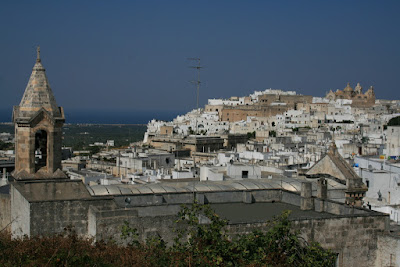
It was also the home of our very first gelati, which we enjoyed whilst taking a stroll through the atmospheric streets and alleyways of the old town. And can I just say that the yoghurt flavoured gelato absolutely rocks!
LEECE
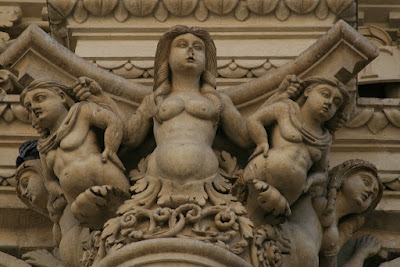
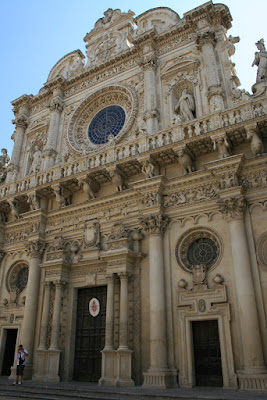
The university town of Lecce was one of our top destinations on the Salento peninsula, famous for it's incredibly 'madcap' Baroque architecture. So madcap infact that it's given birth to its very own style of Baroque, known as Lecce Baroque. According to Lonely Planet, one 18th century traveller of note thought it the most beautiful city in Italy, while another - one Marchese Grimaldi thought that the facade of the Basilica di Santa Croce looked like a lunatic's nightmare...
Make what you will of it, but it certainly is different. To me, rather like an intricately yet grotesquely sculptured ice cream cake. Unfortunately we couldn't manage to capture an image of the entire church in one photo, so here's a series of frames of the detail. What do you think??
Great town to spend a morning, and given its student population, made for some interesting grafitti. Having just read a book on Berlusconi, Eric was quite taken with this one. Sometimes the most poignant things can be said most with the most little words.
OTRANTO
The last town of note on the 'heel' was Otranto, which once enjoyed fame as Italy's major port to the Orient. Today however, a very picturesque walled town beside the sea, with little evidence of its previous glory - with the exception of course of the 11th century Norman cathedral...
Back in 1480, 18,000 Turks besieged the town, killing 800 faithful Christians who refused to convert. Having taken the town, the Turks then thought nothing of using the cathedral to stable their horses. Amazing then that some of the most fabulous floor mosaics we have ever seen - if not the most simplistic in design, ever managed to survive. They are truly amazing! Depicting some really bizarre scenes of heaven and hell, with a menagerie of animals - monkeys, snakes, sea creatures - to our mosaic loving eyes they looked more like comic book animations than actual classical designs. It's really unfortunate, but no photography was allowed, and we didn't even manage to sneak in a quick one : (
The other truly weird thing about this church, is that the locals somehow managed to gather up the skulls and bones of the 800 or so marytred Christians from the 1480 siege, and have used them to decorate the side chapel. And I mean floor to ceiling stackings of the things. Lovely.
Today, aside from the ghoulish freak show in the cathedral, the main attractions in the old walled town appear to be the endless supply of delicatessens, gelaterias (from which we managed to abstain) and souvenir shops. Give me the skulls anyday!
The maddening crowds in Alberobello were quite sympathetic compared with what lay in store for us, but somewhere amongst all of this - most notably in the small inland towns we managed to find some respite, a quiet corner in the heat of the day (now that's another story!) and many a good gelato...
Here are some of our highlights...
OSTUNI
A wee detour en route to Lecce, Ostuni is a beacon of white washed buildings draped across a hill overlooking the dry, olive tree covered plains that marks the end of Truilli country and the start of the Salento peninsula - otherwise known to you and me as the heel of Italy.
It was also the home of our very first gelati, which we enjoyed whilst taking a stroll through the atmospheric streets and alleyways of the old town. And can I just say that the yoghurt flavoured gelato absolutely rocks!
LEECE
The university town of Lecce was one of our top destinations on the Salento peninsula, famous for it's incredibly 'madcap' Baroque architecture. So madcap infact that it's given birth to its very own style of Baroque, known as Lecce Baroque. According to Lonely Planet, one 18th century traveller of note thought it the most beautiful city in Italy, while another - one Marchese Grimaldi thought that the facade of the Basilica di Santa Croce looked like a lunatic's nightmare...
Make what you will of it, but it certainly is different. To me, rather like an intricately yet grotesquely sculptured ice cream cake. Unfortunately we couldn't manage to capture an image of the entire church in one photo, so here's a series of frames of the detail. What do you think??
Great town to spend a morning, and given its student population, made for some interesting grafitti. Having just read a book on Berlusconi, Eric was quite taken with this one. Sometimes the most poignant things can be said most with the most little words.
OTRANTO
The last town of note on the 'heel' was Otranto, which once enjoyed fame as Italy's major port to the Orient. Today however, a very picturesque walled town beside the sea, with little evidence of its previous glory - with the exception of course of the 11th century Norman cathedral...
Back in 1480, 18,000 Turks besieged the town, killing 800 faithful Christians who refused to convert. Having taken the town, the Turks then thought nothing of using the cathedral to stable their horses. Amazing then that some of the most fabulous floor mosaics we have ever seen - if not the most simplistic in design, ever managed to survive. They are truly amazing! Depicting some really bizarre scenes of heaven and hell, with a menagerie of animals - monkeys, snakes, sea creatures - to our mosaic loving eyes they looked more like comic book animations than actual classical designs. It's really unfortunate, but no photography was allowed, and we didn't even manage to sneak in a quick one : (
The other truly weird thing about this church, is that the locals somehow managed to gather up the skulls and bones of the 800 or so marytred Christians from the 1480 siege, and have used them to decorate the side chapel. And I mean floor to ceiling stackings of the things. Lovely.
Today, aside from the ghoulish freak show in the cathedral, the main attractions in the old walled town appear to be the endless supply of delicatessens, gelaterias (from which we managed to abstain) and souvenir shops. Give me the skulls anyday!
Subscribe to:
Posts (Atom)